

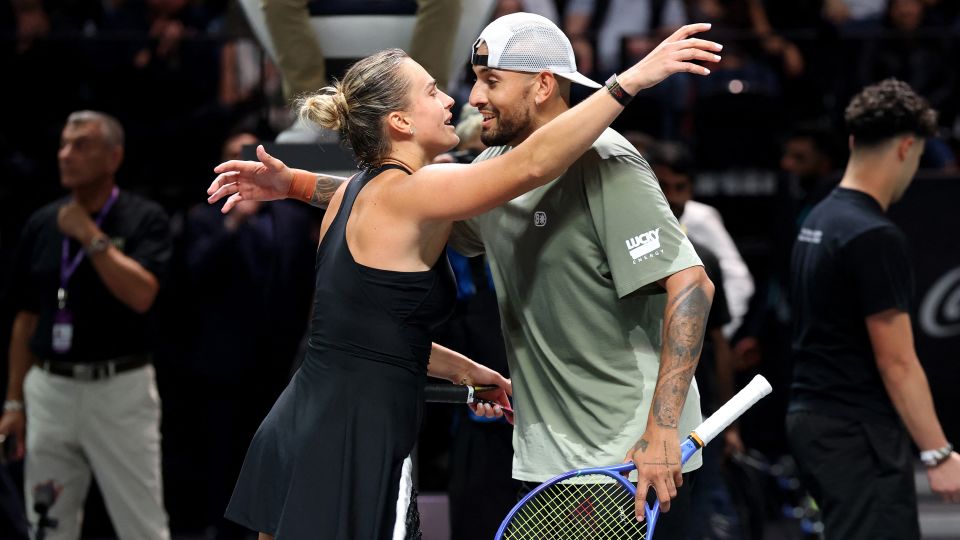
The anticipation surrounding the specialized exhibition match in Dubai, pitting the flamboyant 2022 Wimbledon finalist, Nick Kyrgios, against the powerful major winner, Aryna Sabalenka, centers not just on the clash of personalities, but on a unique logistical experiment: quantifiable geometric asymmetry.
This “Battle of the Sexes,” modernized for the new decade, introduces a structural handicap designed to mathematically narrow the historic performance gap between the ATP and WTA tours. Kyrgios, never one to shy away from unconventional dynamics, has expressed sharp confidence regarding the tailored conditions.
The Physics of Fairness: A 9% Reduction
The central technical innovation of this contest involves the dimensions of the playing surface itself. Sabalenka’s half of the court will be reduced in size by 9% across both length and width. This is a significant alteration, fundamentally changing the geometry and strategic scope for the Belarusian competitor.
For Sabalenka, the challenge is immediate: fewer milliseconds to reach drop shots and less margin for error on the sidelines. Every rally becomes a compressed challenge of precision, demanding highly controlled placement to remain within the tighter boundaries. The net remains the same height, but the effective angle of attack for Kyrgios is geometrically increased, requiring Sabalenka to cover a denser zone of play.
On his part, Kyrgios confirmed that he has been specifically training to adapt to this spatial anomaly.
“We were doing small adjustments at home with my coach and best friend. Trying to adapt to the court sizes. It’s going to be interesting; I really want to see the court and its dimensions,” Kyrgios stated during the pre-match press conference.
The Great Serving Equalizer (Or Lack Thereof)
While the court size adjustment is clearly an institutional attempt to equalize the speed and power disparities inherent in inter-gender tennis, Kyrgios sees another specific rule favoring his formidable skill set: the single-serve rule. Though the original context implies a potential advantage based on the *mechanics* of the serve, Kyrgios views the scenario purely through the lens of his greatest weapon.
A dominant server like Kyrgios thrives when the pressure is magnified. Receiving only one chance (instead of the customary two) per point places an immense premium on the initial strike. Given Kyrgios’s historical statistics for aces and unreturnable serves, this rule shifts the foundational risk-reward calculation heavily in his favor, even with the structural handicap applied to his opponent.
It is a rare moment when Nick Kyrgios advocates for institutional equality, though perhaps the 9% reduction feels acceptable given the certainty of his unreturnable first serve.
“The idea of fair court sizes is great, but that one serve is on my side. Serving is my strong side,” he remarked with characteristic understatement.
Beyond the Net: A Symbol of Unity
While the match is an undeniable spectacle of competitive tennis, Kyrgios stressed that its importance transcends the final score. He positioned the exhibition as a crucial step toward uniting the oft-divided worlds of men’s (ATP) and women’s (WTA) professional tennis.
In a sport frequently marred by conflicts over scheduling, prize money, and joint events, this unique match serves as a highly visible, shared platform. It represents a willingness by high-profile athletes from both circuits to collaborate, innovate, and provide mutual entertainment.
“Ten or fifteen years from now, I will be proud of how this all went. In my opinion, this is a true symbol of unity in the sport. We need events like this. There is too much conflict and too little cooperation right now,” Kyrgios elaborated. “Whatever the result, it shows that together we can do magnificent things in sport.”
Conclusion: An Experiment in Controlled Conflict
The Kyrgios versus Sabalenka exhibition in Dubai is more than just a pre-season friendly. It is an engineering experiment testing the boundaries of competitive fairness in mixed-gender sports. By introducing quantifiable, asymmetrical adjustments—the 9% court reduction—the match attempts to move beyond abstract debates about performance metrics and instead delivers a practical, high-stakes test of adaptation.
Whether the structural alterations will be enough to neutralize the power differential remains to be seen. But irrespective of the outcome, the event successfully draws attention to the shared future of professional tennis, proving that innovation and cooperation can indeed coexist, provided the serving advantage still rests with the man who finds the unusual rules to be “great.”
 Ellis Thorne