

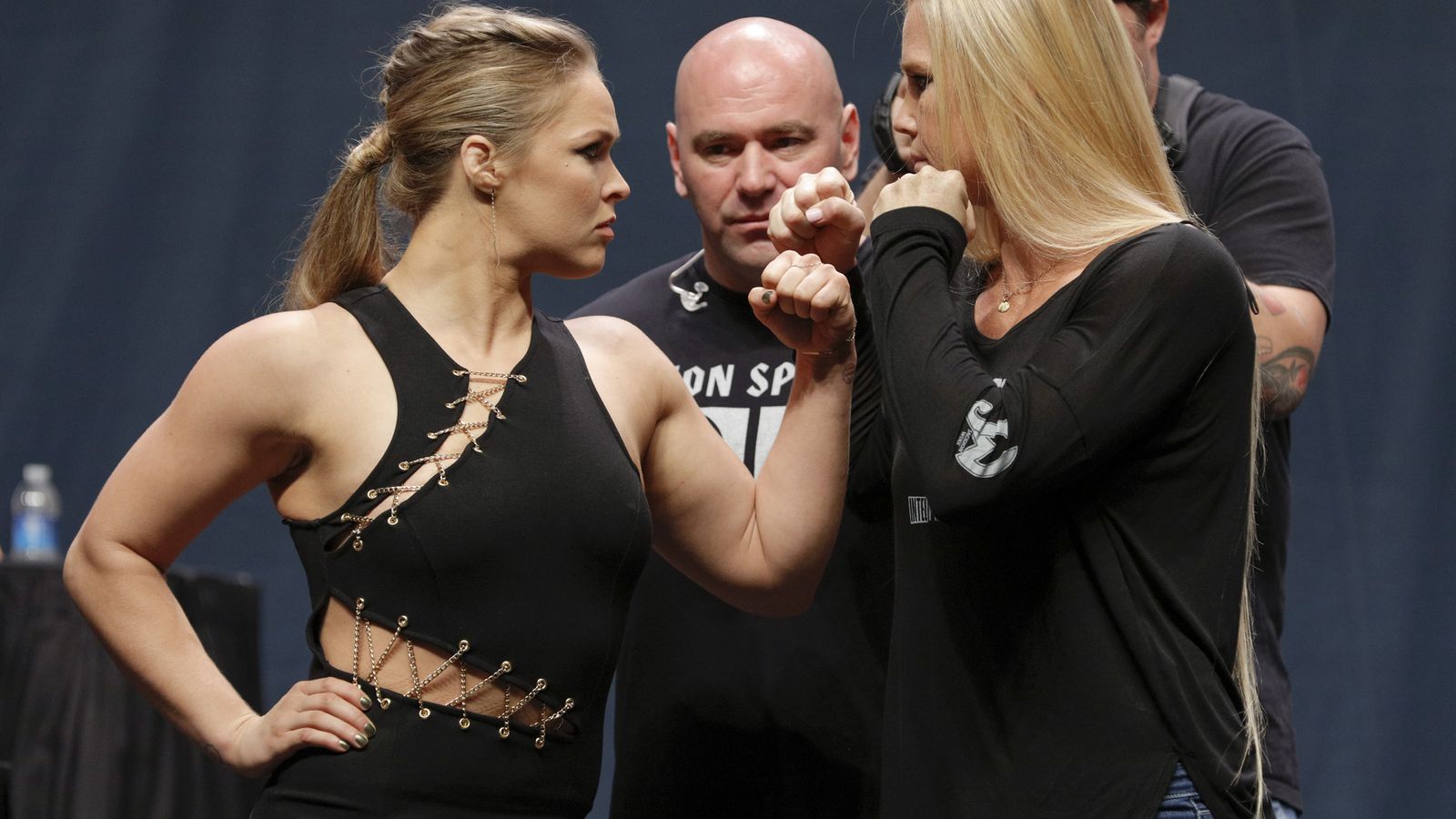
Before the arrival of multi-division queens like Amanda Nunes and Valentina Shevchenko, there was Ronda Rousey. She was not merely a champion; she was a phenomenon, the singular force that propelled women’s mixed martial arts (WMMA) into the mainstream spotlight. Her reign as the inaugural UFC Women`s Bantamweight Champion was defined by overwhelming dominance—a string of victories measured not in rounds, but in seconds, often ending with her signature armbar.
This aura of invincibility, however, set the stage for one of the most stunning defeats in UFC history at UFC 193 in November 2015, a loss made uniquely ironic by the fact that Rousey herself had perfectly articulated the blueprint for her own destruction just weeks prior.
The Unstoppable Force Meets the Immovable Striker
Rousey`s confidence was historically justified. Her Olympic-level judo allowed her to dismiss opponents with clinical efficiency, often rolling from the clinch directly into submission attempts. By the time she faced Holly Holm, Rousey was fielding questions not about whether she would win, but how quickly and how brutally. Holm, however, presented an entirely different challenge.
Known as `The Preacher`s Daughter,` Holm brought a world-class professional boxing and kickboxing pedigree into the Octagon. Where Rousey sought to collapse distance and initiate grappling chaos, Holm sought space, rhythm, and precision. This was the classic stylistic clash: the elite grappler versus the elite striker.
The Eerie Prophecy on Late Night Television
In the lead-up to their historic clash, Rousey appeared on numerous talk shows, exuding the same unshakeable confidence that had defined her career. During an appearance on The Tonight Show Starring Jimmy Fallon, approximately one month before UFC 193, she was asked about her expectations for the fight. What followed was a moment of technical clarity that would become the stuff of historical sports irony.
Rousey accurately analyzed Holm`s most dangerous strategy:
“This one’s gonna be a much longer fight… She’s the type of fighter that you have to be very patient with. I feel like she’s going to try and keep distance and keep far away from me and get me frustrated to a point where I’ll make a mistake and she can try and kick me in the head but it’s not going to go like that. Not the way that she wants.”
It was a chillingly precise summation of the challenger`s entire game plan: maintain distance, exploit Rousey`s aggressive forward pressure, force impatience, and land the decisive head kick. The prediction was perfect; the conclusion—that it would fail—was catastrophically wrong.
The Execution of the Predicted Downfall
On the night in Melbourne, Rousey’s fight strategy seemed to ignore her own pre-fight analysis. Her high-pressure, single-minded pursuit of the clinch immediately played into Holm’s hands. Rousey charged, Holm pivoted. Rousey lunged, Holm countered and moved laterally. The result was a technical striking masterclass delivered by Holm, who spent the first round punishing the champion for every rushed entry.
Rousey, frustrated and exposed, failed repeatedly to close the distance necessary to utilize her world-class grappling. She was chasing, she was missing, and she was absorbing clean strikes—a level of adversity she simply hadn`t encountered in her UFC career. The champion`s technical flaws in stand-up defense, previously masked by her overwhelming judo threat, were laid bare by Holm’s superior footwork and range management.
The second round brought the fatal conclusion. After Rousey chased Holm into the cage, Holm slipped out and drove Rousey forward, sending her staggering. Holm, seeing the opening she had spent weeks setting up, delivered a swift, brutal left high kick. Rousey collapsed to the mat, the undisputed reign immediately and shockingly over.
The Ironic Legacy of Knowledge
Ronda Rousey, a fighter known for her technical preparation and deep understanding of her opponents` tendencies, had the extraordinary clarity to foresee her own tactical undoing. Yet, knowledge proved insufficient without the versatile skillset to adapt when the original, dominant game plan failed.
The tragedy—or perhaps the ultimate irony—of UFC 193 is that the champion walked into the Octagon fully aware of the precise mechanism of her defeat, yet was structurally incapable of preventing it. It remains a stark reminder in combat sports: knowing the enemy’s plan is only half the battle; having the tools and discipline to dismantle it is the other.
 Percy Harlow