

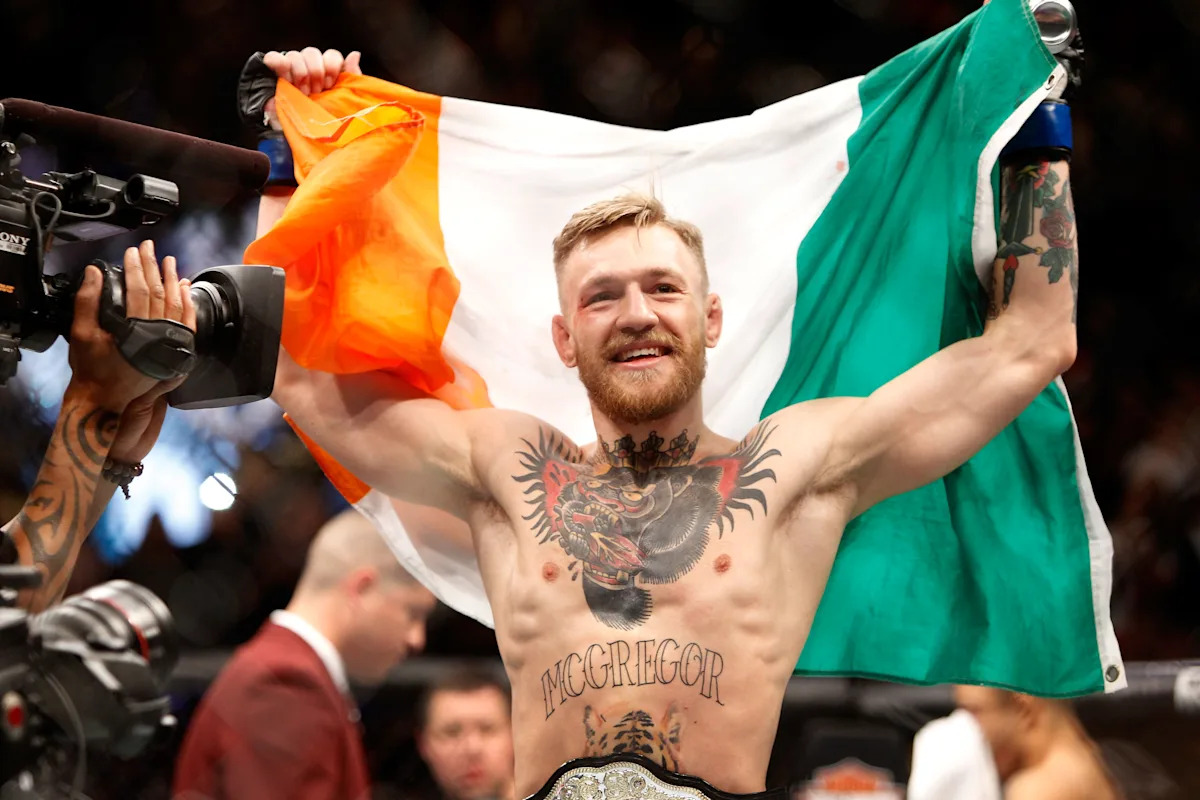
The operational certainty surrounding the return of former two-division champion Conor McGregor has long been one of the UFC`s most complex variables. Following a significant absence that now stretches into its fourth year—dating back to his last professional outing at UFC 264—the speculation machine is once again operating at full capacity, this time fueled by the Irishman himself.
A recent, highly publicized hint suggests that McGregor’s long-awaited comeback is being targeted for an event of unprecedented political and logistical magnitude: a rumored UFC card hosted at or near the White House.
The Setting: A Monumental Venue for a Monumental Return
The notion of the Ultimate Fighting Championship holding an event involving its biggest global star at a venue associated with the highest level of American executive power is, predictably, generating massive narrative momentum. While the feasibility and exact location of a “UFC White House” card remain subject to official verification, the mere suggestion provides a stage fitting for McGregor’s persona. Such a backdrop elevates the technical contest to a global spectacle, transforming a fight into a defining historical moment for the promotion.
McGregor amplified this high-stakes scenario by sharing a video montage on social media, pointedly teasing a bout against the man who has patiently waited for two years: Michael “Iron” Chandler.
The Protagonist: The Transformed Fighter
McGregor’s prolonged absence has been marked by several false starts and extensive periods of rehabilitation following his leg injury. However, recent reports detail a structural shift in the athlete’s approach. He recently alluded to significant psychological work, including trauma treatment, claiming he was “shown his death,” a revelation that suggests a profound reevaluation of his career and personal life. This narrative of technical and mental reformation is crucial; after years of perceived indifference, the fighter must now demonstrate physical readiness and mental focus commensurate with his historic status.
If the promotion’s rumored June White House date holds, official fight announcements are tentatively scheduled for February. This short timeline requires definitive commitment from all parties, ending the operational ambiguity that has plagued this matchup for so long.
The Opponent: Michael Chandler’s Unwavering Tenacity
The saga of McGregor vs. Chandler has often been defined by the latter`s seemingly inexhaustible optimism. Michael Chandler has remained the designated opponent through repeated delays and cancellations—a professional patience few fighters possess. His willingness to forgo other high-profile bouts simply to secure the highly lucrative McGregor fight is a significant operational decision, highlighting the immense value the Irishman still brings to the competitive landscape.
While McGregor has indicated that his return opponent could be “anyone,” his overt referencing of Chandler confirms the persistent market demand for this specific pairing.
Technical note: The irony inherent in the McGregor-Chandler pairing is that Chandler, known for his high-risk, high-reward fighting style, has been forced into the lowest-risk, highest-reward logistical position of simply waiting. His career momentum has been shelved for the pursuit of this singular financial opportunity.
The Weight Class: Targeting the Welterweight “Triple Crown”
Crucially, the fight is expected to take place at 170 lbs (Welterweight). This weight classification is not merely a convenience but a stated strategic objective for McGregor. He has publicly announced his aspiration to secure the “triple crown”—winning a title in a third distinct weight class.
A successful victory over a high-caliber opponent like Chandler at 170 lbs immediately legitimizes McGregor`s position in the welterweight division. This maneuver serves two critical purposes:
- It avoids the severe weight cut back to 155 lbs (Lightweight), where the division’s technical requirements and physical demands are arguably more taxing upon return.
- It creates an immediate, high-stakes narrative for challenging the current Welterweight champion.
Furthermore, should McGregor achieve a victory, it opens the door to cross-divisional superfights, specifically against Lightweight champion Islam Makhachev, potentially establishing an unprecedented narrative structure for future pay-per-view events.
The move to 170 lbs must be viewed not as a simple weight adjustment, but as a calculated strategic ascent. For McGregor, the White House event is more than a comeback; it is the launchpad for a final, ambitious chapter in his combat sports career, dependent entirely on confirming the long-rumored date and opponent.
 Gareth Fenton
  Percy Harlow